
Castles and residences · Ossana · Val di Sole
Castello di San Michele
On the road to the Tonale since the 12th century: held by the bishops, then the Federici, then a ruin saved from decay.
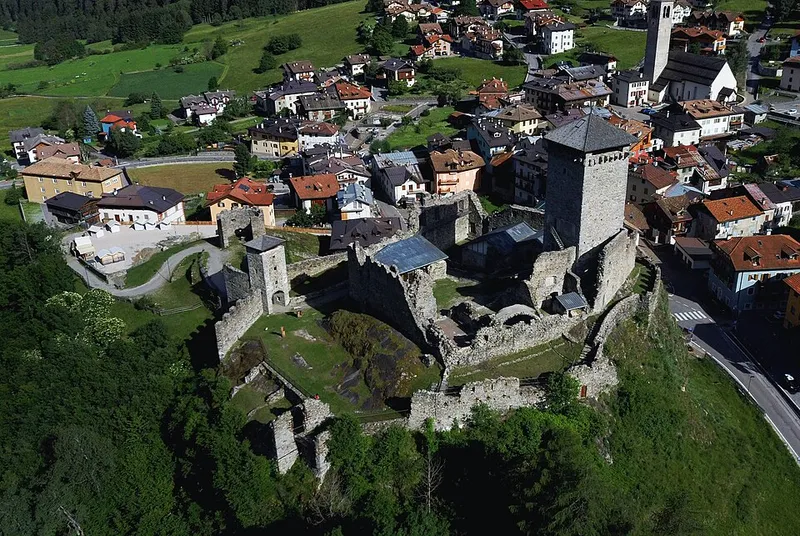


From above
Right above it
It stands above Ossana, on a spur of rock that is otherwise inaccessible, with the entrance on the east side, and it watched over the road of the Passo del Tonale: the route by which merchants and caravans climbed towards the Trentino and the Tyrol from the valleys of Brescia and Bergamo and from Lake Garda. It was not only a garrison post. It was part of the properties of the bishop of Trento, and the tributes of the valley were gathered here, often paid in kind, with the produce of the fields.
The excavations have found pottery from prehistoric times and fragments from the centuries between the 5th and the 7th, some of them walled into structures older than the church: perhaps there was already a guard post on the rock, but the evidence does not allow us to go beyond a hypothesis. The first written record of the castle is a deed of sale of 1191. The church of San Michele, which gave its name to the whole complex, appears in 1213: it was not the church of the village's faithful but a place of power, where the bishop Federico Vanga summoned men and witnesses for investitures. Two years later he had its roof repaired.
Then the castle passed from hand to hand. In 1239 the emperor Federico II took the fortifications of the Noce valley away from the Church of Trento and entrusted the castle to the podestà Sodegerio da Tito; in 1274 the area belonged to Count Mainardo of Tyrol, in 1290 the bishop Enrico II was still demanding its return together with the whole of the Val di Sole, and in 1337 the count of Tyrol handed it over to Duke Giovanni of Luxembourg.
Its finest period begins in 1412 with Giacomino de Federicis, from a family of Erbanno in Valcamonica, appointed episcopal vicar of the Noce valley, who received the rock as a fief. It was he who made a true castle out of the garrison post: a noble residence, the keep, the church and the old palace partly incorporated, and two circuits of walls with the entrance defended by a tower and a drawbridge. The keep, twenty-five metres high, carries at its top a crowning that projects on corbels, with the machicolations from which the base was defended.
The fortunes of the Federici did not last long. After the death of his son Federico in 1470, the castle passed to the counts Thun, and in 1525, during the Peasants' War, the peasants of the valley in revolt seized it. The Federici regained it as vassals of the bishop until they died out in 1567; in 1581 the bishop Ludovico Madruzzo granted it to Cristoforo Federico Heydorff, and in 1640 it passed to the Bertelli of Caderzone. By then it was no longer needed for war: maintenance became less frequent, and in 1777 a great fire destroyed its roofs and part of its walls.
In 1822 the Austrian military engineers strengthened its defences one last time. In 1843 the state property office sold it to Count Giuseppe Sizzo de Noris, some of the internal buildings became farm buildings, and in 1922 the Taraboi family of Ossana took over what remained of it. Since 1992 it has belonged to the Provincia autonoma di Trento, which has removed the trees that had grown among the walls, secured the rock and consolidated the keep, choosing to preserve it as a ruin rather than rebuild it: the walls, made with the stone of the rock on which they stand, still keep its colour. The works were completed in July 2014, and today the castle can be visited with guides and hosts events. Of the church there remain the foundations, the base of the altar, a single-light window and fragments of frescoes.
- First record
- 1191
- Keep
- 25 m
- Provincial property
- since 1992
- Protection
- Italian cultural heritage