
Castles and residences · Ville d'Anaunia · Val di Non
Castel Valer
The octagonal keep, unique in the Alps, and the castle that Trento bought in 2023.
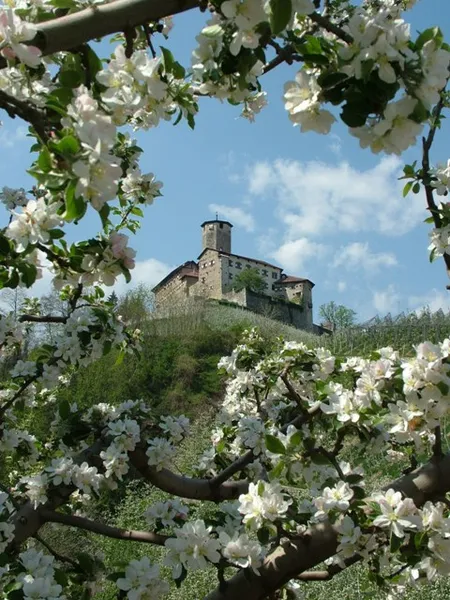

It stands at 594 metres on a hill above Tassullo, in the municipality of Ville d'Anaunia, with a moat to the north and, to the south, the drop into the gorge of the rio Paglia, which over the centuries has several times eroded the slope. The name perhaps comes from the chapel of San Valerio, but according to the historian Walter Landi it also expresses the valour and prowess of chivalric culture. It was long written that it was founded in 1211 by the counts of Appiano; the documents say otherwise. The first record dates from 1297, and the construction, judging by the rusticated ashlar of the keep, cannot be earlier than the thirteenth century: according to Landi it was begun in 1266 by the brothers Riprando and Nicolò II of Flavon, while Trento was in the hands of Mainardo II of Tyrol. In 1301 it belonged to Ulrico di Coredo, and on 29 December of that year the peace was signed there between the sons of Mainardo II and the cities of Mantova and Verona, which ended the count's war with the bishop.
It changed hands many times, as a pledge and as a fief: to the Coredo until around 1340, to Corrado di Teck, in 1354 to Ludovico of Brandenburg, husband of Margherita of Tyrol, then to the Habsburgs, to the Greifenstein, and in 1386 to Warimberto III di Thun for 2,400 florins. In 1427 it was held by the brothers Giovanni and Giorgio Spaur: the first founded the line of Valer di sopra, the second that of Valer di sotto, and for more than four hundred years the castle remained divided in two. In 1895 Count Giulio Spaur bought the lower part and reunited it. Count Ulrico Spaur lived there until his death, in February 2021; the Autonomous Province of Trento bought it from his heirs for 15.4 million euros, with the contract signed in June 2023.
The octagonal keep dates from the second half of the thirteenth century, and was raised in the mid-fifteenth century to today's height of 30.55 metres with the roof, with walls two metres and thirty centimetres thick and the entrance almost seven metres above the ground, reached by a wooden bridge that could be brought down. It is built of limestone, porphyry and tonalite, the stone of the Adamello that came from the Tonale. The eight-sided form has no equal in the Trentino and, according to Landi, in the Alpine arc: it would be the last sign of the Swabian empire in Italy, linked to the descent of Corradino and the occupation of Trento in 1266, with the octagon as a symbol of the Empire.
From the fifteenth century the Spaur enlarged it: the successive circuits of walls enclose the lower castle, the oldest, and the upper one, built to live in. Inside are the Sala degli stemmi, with the arms of the related families (Visconti, Madruzzo, Thun, Fugger, Trapp, Welser), the Gothic kitchen with its original furnishings, the Salone di Ulrico with its ceiling of 1552 and the family portraits, the majolica stoves of Sfruz, and the Sale madruzziane, with friezes by Marcello Fogolino, the painter of the prince-bishops, called in for Caterina Madruzzo, sister of Bishop Cristoforo and wife of Ulrico Spaur. The chapel of San Valerio, commissioned by Rolando Spaur, was consecrated on 15 November 1473 and frescoed by the brothers Giovanni and Battista Baschenis, painters from Bergamo: evangelists, prophets, San Romedio with the bear, the Passion, the Adoration of the Magi. In 1706 a flood of the rio Paglia caused the slope to give way and part of the upper castle to collapse, and it was later rebuilt; between 2001 and 2005 the Province made the hillside safe.
- First record
- 1297
- Keep
- 30.55 m with the roof
- Owned by the Province
- since 2023
- Protection
- Italian cultural heritage property