
Castles and residences · Ton · Val di Non
Castel Rocchetta
It was demolished in 1860 to make way for the fort that can still be seen.


From above
194 metres from here
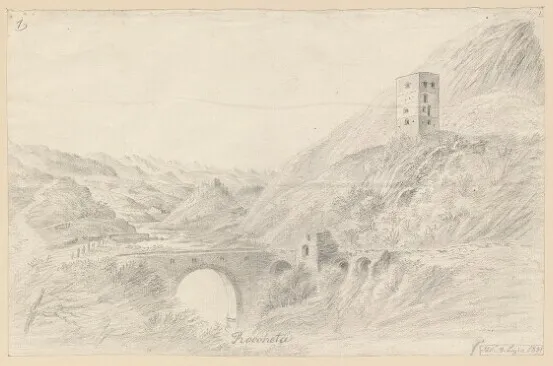
Almost nothing remains of this castle, and the reason lies a few metres away: the tower was pulled down in 1860 to make way for the construction of the Rocchetta road cutting, the Austro-Hungarian fort with eleven cannons that still guards the same narrow pass. The building had already been partly dismantled in 1810.
It was built for the same reason it was destroyed: to control the passage. In February 1333 King Henry of Bohemia commissioned his vassal Volkmar von Burgstall to build a tower to fortify the narrow pass, near the bridge over the Noce, promising to pay the costs; the promise remained empty, and in the end the king handed the building over to Volkmar as a feudal pledge. Volkmar was already castellan of Castel Visione, which stands a few hundred metres higher up.
Castellans appointed by the Tyrolean territorial princes followed: Konrad von Schenna after Volkmar fell out of favour in 1342, then three generations of Rottenburg. In 1410 the troops of Duke Frederick IV occupied the castle, accusing the Rottenburg of having fuelled the dispute between the duke and the Bishop of Trento Giorgio di Liechtenstein; the bishop then put forward claims of his own and in 1418 managed to take it with the help of Pietro di Spaur, and only two years later, once the Spaur feud had been settled, the castle returned to the Tyroleans.
Its distinctive feature is that it was an island. Castel Rocchetta was one of the Tyrolean enclaves inside the Val di Non, which belonged to the prince-bishopric of Trento: around the middle of the fifteenth century a customs station of the Tyrolean prince was set up there, and the castellan and the customs officer together exercised jurisdiction over a district of a few hundred metres all around. In 1534 the building and the customs post passed to the Thun, who renovated the complex and in 1555 built a cistern there.
What remains of how it looked are the images and the excavations. The first depiction is by Pier Andrea Mattioli, in the sixteenth century, who in his map draws it with a massive keep and a building beside it above the Noce; in the Codex Brandis, from the seventeenth century, it appears as a tower surrounded by a crenellated wall; in the drawing made by Johanna von Isser Großrubatscher in 1831 the keep already looks like a ruin. The excavations of the 2000s have yielded fragments of pottery and glass, nails and weapon points, and coins ranging from the fourteenth to the nineteenth century.
- First commission
- February 1333
- To the Thun
- from 1534
- Tower demolished
- 1860
Trails that pass through here
- O516BSentiero attrezzato del CronelloEE3 kmabout 450 m away
From the register of alpine trails of the Autonomous Province of Trento. © SAT.