
Castles and residences · San Michele all'Adige · Piana Rotaliana
Castel Monreale
Castrum regalis: the castle of 1238 that gives its name to the Comunità della Piana.
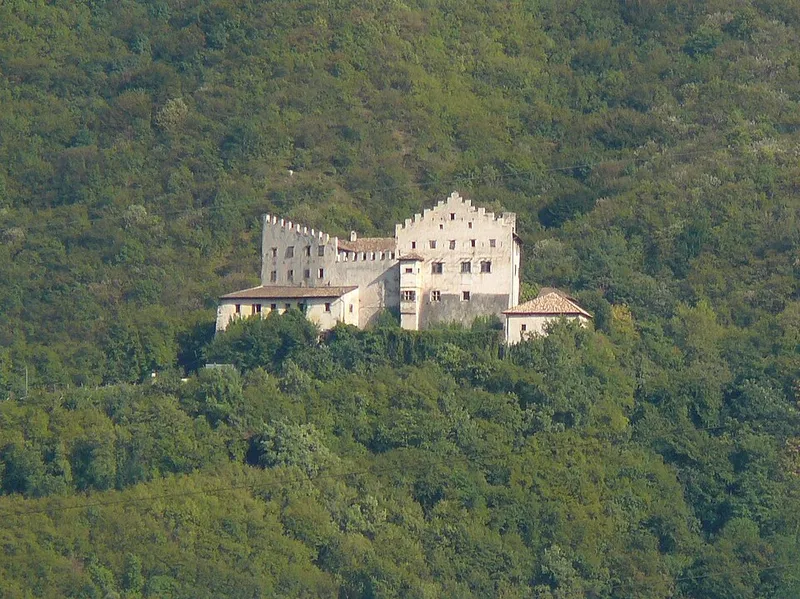

It stands on the heights of Faedo, above the vineyards, and appears in documents in 1238 as castrum regalis, then castrum Cunispergi: in German Königsberg, the name now borne by the Comunità Rotaliana-Königsberg. It is painted in a medieval fresco in the church of Sant'Agata, in the village. It was built by the counts of Appiano, who in the early fourteenth century held sway as far as the Val di Cembra, and in 1243 Bishop Egnone di Appiano held it as a fief of the Church of Trento together with his nephews.
In 1276 it was granted in fief to Mainardo II, count of Tyrol, and from then on it remained with the counts and, from 1363, with their heirs, the Habsburgs, who placed captains and vicars there. From 1407 to 1559 it was held by the Thun, who between 1508 and 1559 made it into a Renaissance castle: in the knights' hall the large fireplace with its marble architrave and the Thun-Neideck coats of arms remain, and in the reception rooms the frescoed friezes and the painted chapel, perhaps under Sigismondo Thun, who also built palazzo Thun in Trento. The Thun returned from 1627 to 1648.
In 1648 the Habsburgs, who had borrowed money from the Venetian Zenobio family, granted them the castle in fief together with the lordships of Enn, Caldiff and Salorno, amid protests from the Tyrolean nobility, who did not want a family from the Republic of Venice in Tyrol. From the Zenobio it passed by inheritance in 1817 to the counts Albrizzi, and in the twentieth century to the barons Rubin de Cervin Albrizzi.
Over the centuries alterations have obscured its original form; what remains is the large hexagonal tower, the crenellated curtain wall and the private chapel. Since 1976 it has belonged to the Schmid family, winegrowers from Merano, who have extended the vineyard to twenty-nine hectares and in 1986 redid the roofs. It is private property and the seat of a wine estate.
- First mention
- 1238
- Renaissance phase
- 1508-1559
- Protection
- Italian cultural heritage