
Castles and residences · Cles · Val di Non
Castel Cles
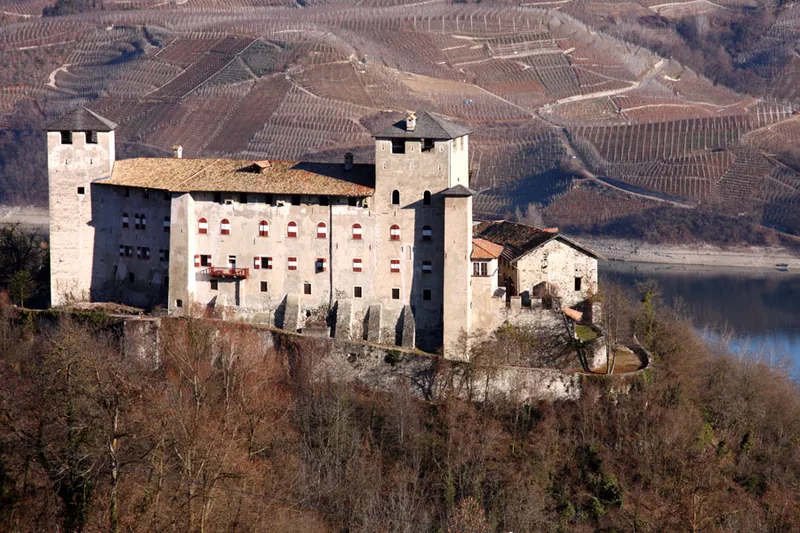
The house of the Cles family, rebuilt by Bernardo Clesio, reflected in Lake Santa Giustina.


From above
1434 metres from here
It stands at 616 metres on the top of a promontory one kilometre north of Cles, among the apple trees that run down to the lake. Today it is reflected in Lake Santa Giustina; before the dam it watched over the gorge of the Noce and the wooden bridge that joined Cles to the upper Anaunia, now underwater. It may have been built on the remains of a Roman watchtower, and at the beginning it belonged to a consortium, as its several towers suggest; from that circle, in the first decades of the twelfth century, emerged the family of the lords of Cles, whose founder is Vitale de Clesio.
Its most illustrious man is Bernardo Clesio, cardinal and prince bishop of Trento, chancellor and president of the Privy Council of King Ferdinand I, Renaissance humanist and patron of castles, palaces and churches. After the damage of the Peasants' War of 1525 it was he, with his nephew Ildebrando, who had the castle rebuilt according to Renaissance canons: the works ended in 1535, as the plaque on the courtyard wall says. In the baronial palace, between the towers called Tor di qua and Tor di là, there is the Saletta delle Metamorfosi, frescoed by the court painter Marcello Fogolino with scenes from Ovid.
Further works were carried out in 1597. In 1609 a lord of Cles, Ildebrando Reimberto, was legally barred from managing his affairs and shut up in his own castle so that he would not ruin the family with his spending, and the following year his wife, Elena Thun, was still complaining about him. The castle had three towers: a fire in 1825 destroyed one wing and one tower, and with them the family archive.
Legends still dwell in it: the witches' chamber, where every Saturday at midnight the witches of the valley were said to gather before climbing the Roen; the mule's bridge, built by a baron in gratitude to the animal that, fleeing from enemies, was said to have taken flight over the ravine of the rio San Romedio; the stone where Andreas Hofer, on the run, was said to have rested under a cherry tree and a lady of the castle to have refreshed him. It still belongs to the barons Cles and can be visited only in exceptional cases.
- Renaissance
- 1535
- Altitude
- 616 m
- Protection
- Italian cultural heritage asset