
Castles and residences · Predaia · Val di Non
Castel Bragher
Seven centuries in the same family, on a spur between Coredo and Taio.
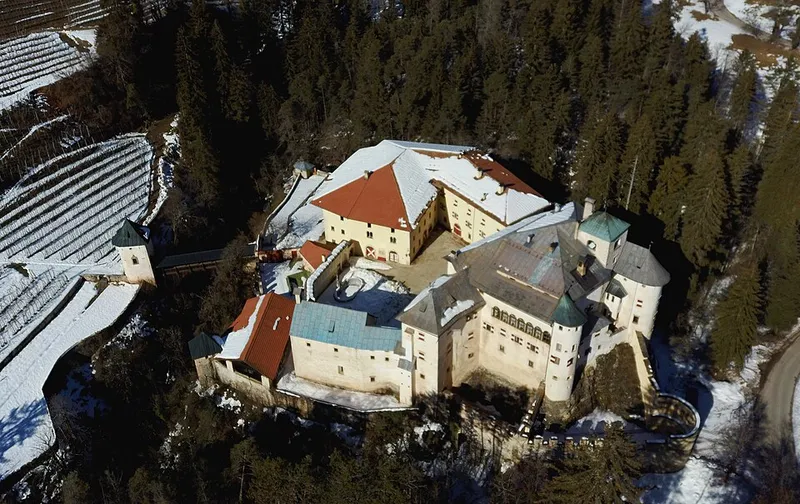

It stands at 640 metres on a crag in a side valley between Taio and Coredo, enclosed by woods and, to the west, by the gorge of the rio Sette Fontane, thirty-four metres deep, which acts as a natural moat. The name comes from Bragherio, of a branch of the Coredo family, who received these lands as a fief from Bishop Egnone in 1270; the castle appears in 1275 as castrum Brageri, and at first it was a watchtower with a curtain wall.
The Thun arrived in 1286, through a marriage, and between 1321 and 1322 Belvesino di Thun bought the shares of the two branches of the Coredo who lived there: Bragher has been theirs ever since, for seven centuries. In 1336 the Arsio tried to take it by surprise and failed; in 1525 the rebel peasants tried and went away empty-handed. In the fourteenth century it was a centre of power: the lords of Bragher appointed the heads of the communities of Coredo, Priò, Smarano, Sfruz, Taio and Tres, and from 1492 they held jurisdiction over the Val di Rabbi. In 1596 the Thun estates were divided among the branches of Ton, Caldes and Bragher, and Giorgio Sigismondo Thun renovated and enlarged the castle.
Over the centuries buildings of different periods have gathered around the courtyard, and the result is a whole that is rustic and noble at once, with Nordic and Italian features, which Aldo Gorfer called the most characteristic castle of the Alpine arc: the red and white shutters in the colours of the Thun, the two round towers of the seventeenth century, the Renaissance loggia, the well with Saint Christopher, and the Torre della Pece beyond the covered wooden bridge over the gorge, which could be brought down in case of siege. The chapel of San Celestino, consecrated in 1452, has a cycle of frescoes of 1461 on the Passion, attributed to a painter from Bressanone. Inside are seventy rooms, paintings gathered after the nineteenth-century restoration, and the library, which holds the most important private archive in the Trentino.
Declining in the Napoleonic age, it was restored from 1857 by Count Francesco Thun-Hohenstein; at the end of the nineteenth century its outbuildings included a silk-spinning mill and about a dozen families lived there. In the 1960s the moat, filled in two centuries earlier, was reopened and crossed by a stone bridge. It still belongs to the Thun and is not open to visitors: you see it from the road, and it already cuts a fine figure.
- First record
- 1275
- With the Thun
- since 1321
- Altitude
- 640 m
- Protection
- Italian cultural heritage property