
Castles and residences · Campodenno · Val di Non
Castel Belasi
The fortress of the Khuen-Belasi, saved by the municipality and now a home for art and ecological thought.
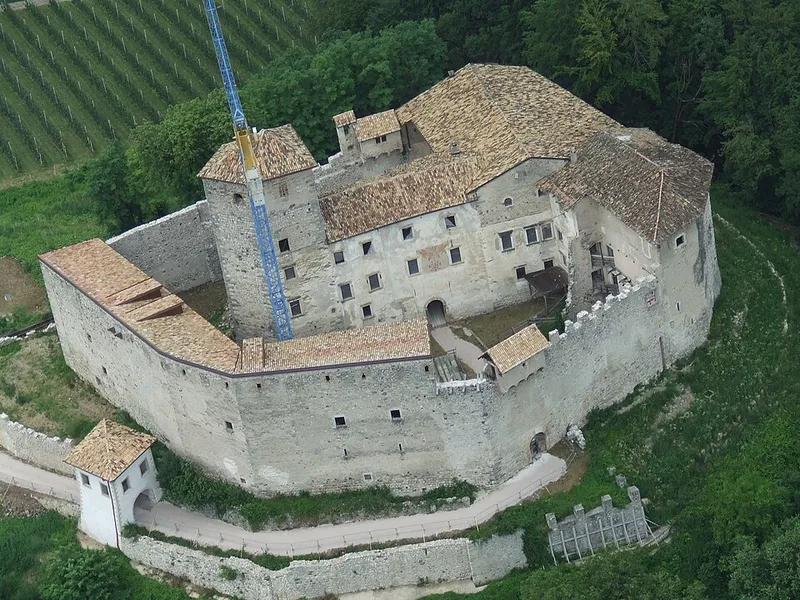


From above
2357 metres from here
It stands on a gentle hill at Segonzone, a hamlet of Campodenno, among woods and orchards, with a pentagonal keep, the high curtain wall with two bartizans above the entrances and, on the south side, two lesser walls joined by a ravelin on the access avenue. It was believed to have existed since the 12th century, with a Belasi family as vassals of the Appiano; the most recent research dates it to the second half of the 13th century, built at the wish of the counts of Tyrol to guard the entrance to the Val di Non, which they had occupied in the war with the bishops of Trento, and entrusted to their captain Ulrico di Ragogna. Belasi would simply be the name of the hill.
In February 1368 it was bought by Corrado, known as Khuen, of Termeno, and the family took its name from it: the Khuen-Belasi, between the 15th and 16th centuries one of the richest and most powerful families in the region, with bishops, politicians and military captains, and branches as far as Vienna, Salzburg and Croatia. They transformed the stronghold into a fortress that was severe outside and elegant inside. It fell twice: between 1415 and 1420 it was held by their rivals the Spaur, and in 1525 the peasants of the Peasants' War plundered its granaries. The families of Lover, Segonzone, Campodenno and Dercolo paid their tithes here, and around the castle grew an estate of fields, vineyards, meadows and woods.
The oldest frescoes, discovered during the restoration in a corridor on the first floor, date from the 15th century: a tournament, coats of arms, crests, musicians. From the 16th century are the Sala della musica e dei frutti, the Judgement of Paris attributed to Bartlmä Dill Riemenschneider and the Sala delle Metamorfosi, with scenes from Ovid; on the façade of the central building the large family coat of arms beneath that of Archduke Ferdinand II, from the 1560s. The chapel of San Martino, in the west courtyard, is linked by a window to a room on the first floor, so that the counts could follow the services even when ill.
Counts of the Holy Roman Empire in the 18th century, the Khuen embellished the castle with stuccoes and majolica stoves; in the 19th century, with their privileges ended, they left it as a summer residence, returned to live in it between the two wars, and in the 1950s abandoned it for good, emptied of its furnishings. In 2000 the Comune of Campodenno bought the whole property, with the little church of Santi Filippo e Giacomo, halted the subsidence of the hill and restored the complex: since 2019 it has been open to visitors and in the warmer season hosts exhibitions, and since 2023 it has been the Centro d'Arte Contemporanea per il Pensiero Ecologico, directed by Stefano Cagol, which works with the MUSE.
- To the Khuen
- from 1368
- Municipal
- since 2000
- Open
- since 2019
- Protection
- Italian cultural heritage