
Castles and residences · Livo · Val di Non
Palazzo Aliprandini Laifenthurn
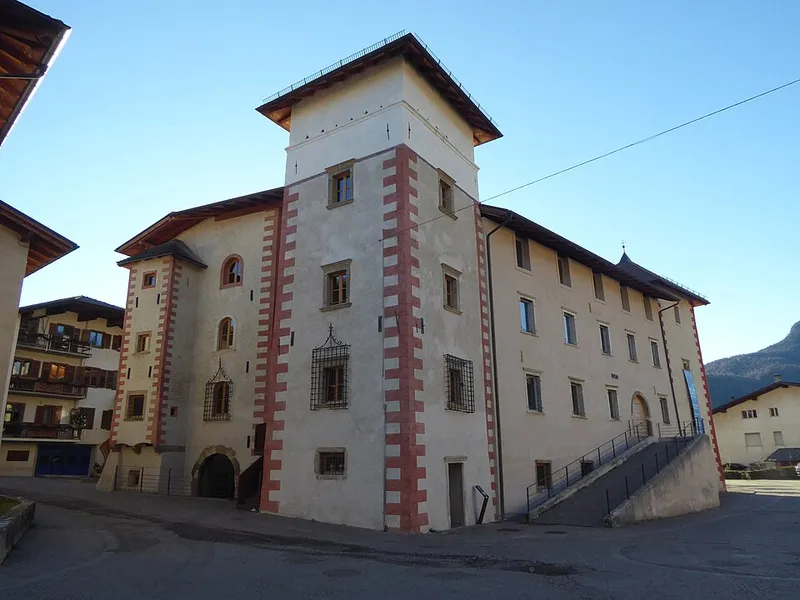
The tower house of the Aliprandini, now Livo town hall, with the rose on its portal.


From above
1202 metres from here
It stands in the centre of Livo and has three names: palazzo Aliprandini Laifenthurn, Toresela, castello della Rosa. The oldest core is a quadrangular defensive tower, built between the 11th and 12th centuries, of which only minimal traces remain; from the 13th century a small tower was added to the south, in the 16th century a second tower, and between the 17th and 18th centuries further buildings that transformed it from a bulwark into a villa. The west façade, on four floors, bears the Aliprandini coat of arms on the portal with the date 1788; the rose in the coat of arms gave the palace its third name.
The Aliprandini appear among the noble families of the bishopric of Trento from the mid-16th century. In 1736 the emperor Charles VI made Giovanni Romedio Aliprandini, court physician to the prince-bishops of Salzburg, a knight, with the right to call himself von Laifenthurn, that is, of the tower of Livo. His son Giovanni Riccardo had fourteen children, and with them the family died out.
In the 19th century the palace passed to the related families of the Bondi and the Zanotelli, and with so many people inside, the spaces were divided up. Since the 1980s the Comune di Livo has bought it piece by piece and restored it: the south wing houses the town hall and the associations, and the rest hosts cultural initiatives. On the north side, with its arched single-light windows, a wooden balcony and the remains of the bread ovens, it keeps a rustic air.
- Oldest tower
- 11th-12th century
- Owned by the Comune
- since the 1980s